Tuesday, May 17, 2016

Rough Ned Odor


It all started with a bat flip.  Back in October.  In another country.  But the Texas Rangers never forgot.  And on Sunday, they did something about it.

Just in case you're one of the 11 remaining people who hasn't seen the video, Jose Bautista got hit by a pitch in the eighth inning of Sunday's game, and it certainly looked intentional.  He then had a hard slide into second base while tying to break up a double play in a one-run game, and Rangers second baseman Roughned Odor took exception.  Odor clocked Bautista right across the face with a punch a boxer would be proud of, setting off a benches-clearing melee that got six people ejected and at least that many suspended.

This fight was ridiculous on so many levels.  First, the pitcher the Rangers appointed to do their dirty work was a rookie that wasn't even on the team during last year's Division Series.  He had nothing to do with it.  Second, this Bautista's last at bat in the last game of the year between the teams.  Now this is going to be the lasting image that sticks with the Blue Jays until they meet again, whether that's in the playoffs or next season.  So, instead of being over, the Rangers made sure it's going to keep going.  It's like Baseball's version of Deflategate.

I'm not saying Bautista didn't have it coming.  After the bat flip, he probably expected some sort of retaliation.  But, logical thinking dictates that the retaliation would come in his first plate appearance in the first game.  Everyone would've seen it coming, Bautista would've taken it, and the whole thing would've been over.  Instead, they play six games without incident before finally taking their shot at him at the end of the seventh.

The timing doesn't make much sense.  Did the Rangers forget until now?  Or did they actually think that putting the tying run on base was a good idea?  Or did they just want revenge against Bautista so much that they didn't care what the situation in the game was?

Odor said he "doesn't regret" anything.  He also expects to be suspended, which he most definitely will be.  I'm putting it in the range of 10 games.  Plenty of others involved in the incident are going to get an MLB-mandated timeout, as well, but none of those suspensions will come anywhere near the length of Odor's.  And they shouldn't.  Because, if you think about it, it wasn't the hit by pitch that started things.  It was Odor.

That's why I think it's so ridiculous people are defending Odor.  They're using crazy reasons such as "he was defending himself," but he's the whole reason the fight started, so I don't see how you can justify anything Odor did.  Bautista was the one who got hit.  Bautista was the one trying to break up a double play.  Was the slide late?  Maybe.  But we're not talking about the Chase Utley Rule here.  The only chance Odor was going to get hurt on that play was if Bautista body-slammed him after the haymaker.

Bautista's not blameless in this situation.  If he doesn't crush a home run that just landed in Winnipeg and stand there looking at it, then toss his bat aside like David Ortiz does all the time, none of this happens.  But it's a stretch to any fault for Sunday's fight anywhere but the Texas Rangers dugout.

Yes, the Rangers got even with Bautista.  But Odor better watch his back.  Because now it's the Blue Jays that have a score to settle.  Why?  Because the Rangers couldn't just hit him right away and be done with.

Sunday, May 15, 2016

Time to Change the Playoff Format

I've been promising this post for a couple days, and with the Western Conference Final set to begin, I figure now's as good a time as any.  The NHL is in the third year of its current playoff format, and I've gone on record as not being a fan.  Because it's not set up the right way.  The best teams shouldn't meet until the conference finals.  Your division shouldn't matter.

For about 15 years in the 1980s, the Stanley Cup Playoffs were 100 percent division-based.  You had Division Semifinals and Division Finals before the Conference Finals.  In a 21-team league with 16 teams making the playoffs, you were essentially guaranteed to make it no matter what.  It was the top four in each division, so as long as you didn't finish last, you were in.

But there were some significant problems with this format.  In the Campbell Conference (which became the West), the Smythe Division, which featured the Oilers and Flames, was much stronger than the Norris Division.  Yet a Norris Division team was guaranteed to be in the Conference Finals, where they would inevitably lose to either Edmonton or Calgary (whichever team survived the other), each season.  It was the same in the Wales (East), but the disparity between the Adams and Patrick Divisions was much less drastic.

The NHL finally realized that this method was stupid in 1993-94, when they renamed the conferences "East" and "West" and went from division-based to conference-based playoffs.  The division winners got the top two seeds, but the remaining six teams would determined solely on points and could come from either division.  And, since it was reseeded after each round, the No. 1 seed was guaranteed to play the "weakest" team that advanced in the second round.  So, if the 7 beat the 2, it would be 1 vs. 7 in the second round instead of 3 vs. 7.  When they split each conference into three divisions, the only change was that the division winners would be seeded 1-3.

That format worked incredibly well.  Yet, for some reason, the NHL decided to change it as a part of the Winnipeg Jets realignment in 2013-14.  And they must've been feeling nostalgic for those division playoff days.  Because, instead of the perfectly fine 1-8 in the conference system they'd been using for 20 years, they essentially went back to the division-based system with a few minor tweaks.  (They also aren't good at math, seeing as there are 16 teams in the East and 14 in the West, but one thing at a time.)

If you finish among the top three in your division, you're guaranteed a playoff spot, with two wild cards going to the two teams with the next highest point totals.  So, in theory, there can be five teams from one division and only three from the other (both the Metropolitan and Central Divisions had five playoff teams this year).  And that only came about after the Union objected to the originally-proposed method of just the top four in each division, using that exact situation as their main point.  (Last year, in fact, both wild cards in the West came out of the Central Division, and they both had more points than Calgary, which got in by finishing third in the Pacific.)  So, the NHL tweaked it, came up with the wild cards, and the Union agreed to the revised format.

Here's the problem with the current format: the bracket is division-based.  The second- and third-place teams in the same division play each other in the first round, and the winner of that series plays the winner of the series involving the first-place team in their division.  But what if one division is significantly stronger than the other?  What if the third-place team in one division was the third-best team in the conference during the regular season?  Not only are they not guaranteed home ice, you're also guaranteeing that either the second- or third-best team won't get out of the first round.  And, since one of the better teams will definitely be knocked out, you're also guaranteeing that a weaker team has to advance.

What's worse, there's no protection for the top team.  Washington and Dallas finished 1-2 in the race for the President's Trophy, and, as such, had home ice in their respective conferences.  But they both had to face the team with the second-highest point in the conference in the second round of the playoffs!  Why?  Because Pittsburgh and Washington are in the same division, and so are Dallas and St. Louis.

Think I'm overreacting to a one-year anamoly?  Well, I'm not.  The NHL has used this format for three years.  Of the six Conference Finals since then, three of them, including both series this year, would've been first-round series if the teams were seeded straight 1-8 regardless of division.  In fact, with the exception of the Eastern Conference last year, the first round would've been totally different:

2014: EAST: Boston-Detroit, Pittsburgh-Columbus, Tampa Bay-Philadelphia, Montreal-Rangers; WEST: Anaheim-Dallas, Colorado-Minnesota, St. Louis-Los Angeles, San Jose-Chicago
2015: WEST: Anaheim-Calgary, St. Louis-Winnipeg, Nashville-Minnesota, Chicago-Vancouver
2016: EAST: Washington-Detroit, Florida-Philadelphia, Pittsburgh-Tampa Bay, Rangers-Islanders; WEST: Dallas-Minnesota, Anaheim-Nashville, St. Louis-San Jose, Chicago-Los Angeles

As you can see, setting up the playoffs based on where you finished in the division instead of the conference has had a major impact...and not necessarily in a good way.  The best teams shouldn't meet until the later rounds.  I don't care if they're in the same division.  If they're the two best teams, they're the two best teams.  And don't you want the best teams to be the ones playing for the Cup?

My solution is incredibly simple.  All the NHL needs to do is change it from division-based to conference-based.  The two division winners get the top two seeds, but the remaining teams are seeded 3-8 based on their regular-season point totals, NOT where they finished in their division.  Because, as this season proved, sometimes the best team and second-best team come from the same division.  And if that's the case, they should meet in the Conference Finals.  Not the semifinals.

Friday, May 13, 2016

Halfway to the Cup

It's eight down, eight to go for the remaining four teams in the Stanley Cup.  But these eight are probably the hardest ones to get.  Just ask the two teams that are left out West.  Either the Blues or Sharks is finally going to play for the Cup (I said to a friend of mine a few weeks ago, "watch them play each other and one will have to not lose").  Neither has ever won it.  San Jose has never even played for it, while St. Louis hasn't been in the Finals since Bobby Orr went flying thru the air.

St. Louis is the only remaining original expansion team (excluding the defunct California Golden Seals) that hasn't won at least one title.  The Blues actually made it to the Finals in their first three years of existence, though, although they're 0-12 all-time in Stanley Cup Finals games, getting swept by the Canadiens in 1968-69 and the Bruins in 1970.

One of the Blues' 1967-68 expansion brethren is the Penguins, who've been the best team in hockey since the calendar flipped to 2016, and they proved it in the Eastern Conference semifinals, where they pretty much dominated Washington for the duration of the series.  The Capitals were the best team in the league for most of the year, but they were outclassed in every way by a Penguins team that's better (and, more importantly, deeper) than they are.  My biggest concern about Pittsburgh heading into the start of the playoffs was their inexperience at goalie, but that's proving not to be an issue.  And, as Pierre McGuire pointed out after their Game 6 clincher against the Capitals, they won the Stanley Cup with a rookie goalie (Marc-Andre Fleury) in 2009.

Of course, they'll have to get past the defending Eastern Conference champion Lightning in order to play for the Cup.  Tampa Bay was challenged big time by the Islanders and certainly had luck (and Nikita Kucherov) on their side, but the Lightning's experience won the day.  They're looking to become the first team to reach the Finals in back-to-back years since...the Penguins, who beat the Red Wings in 2009 after losing to them in 2008.

For the Lightning to get back to the Finals, they're going to need to keep playing at a high level.  Pittsburgh's the better team, but Tampa Bay has the better goalie in Ben Bishop.  That experience of playing Chicago last year can't be discounted, either.  Now, I don't know the status of Steven Stamkos, but his return can only help.  With Stamkos, they have the horses to score with Pittsburgh.  Without him, I'm not sure Tampa Bay has enough.  So, it'll be interesting to see what happens with Stamkos.  The Lightning will monitor his situation closely, and if he can play, he'll play.  And he needs to.  Because I don't see Tampa Bay winning this series without him.

Out West, I think our perennial playoff chokers have both turned a corner.  They were both absolutely dominant in Game 7 victories over Dallas and Nashville.  The Blues' 6-1 win was made all the more impressive by the fact that they smacked the Stars around so completely in Dallas.  They've beaten the defending champions and the top team in the conference in the first two rounds, and they came out of the tougher division.  And they have home ice.  There's reason to be optimistic that the Blues could make their first Stanley Cup Finals appearance in 46 years.

Except San Jose will definitely have something to say about that.  One of the reasons watching the Sharks has been so frustrating in recent years is because everyone knows how much talent they have.  It's finally coming together in the playoffs, and I don't see it stopping.  The Sharks are just on such a roll right now.  They're kind of like last year's Lightning.  You knew they could make a run, you just weren't sure if they would.  Well, they have.  Will it result in the Stanley Cup's first visit to the Bay Area?

There are no division winners remaining, and the top seed in each conference was knocked out by the second-best team in the semifinals (more on that later, but you already know my feelings on the format).  But I don't think there's any doubt that the four best teams are left.  As for who will survive and play for the hardware, it really is a toss-up.  I think we're in store for a pair of long series, and I can see both going either way.

As for my Finals prediction, I've got to go with the two hottest teams.  And that's the Penguins and Sharks.  Pittsburgh beats Tampa Bay in six, and San Jose wins a dramatic Game 7 in overtime in St. Louis.

Wednesday, May 11, 2016

A Great Analogy

There's obviously been a lot of skepticism surrounding golf's return to the Olympics and the number of top players who are opting out of the tournament.  There are plenty of questions, all of which are legitimate, regarding whether or not the players even care about the Olympics and if golf will still be around past the 2020 Tokyo Games.

This isn't the first time a sport's return to the Olympics after a long absence has received a lukewarm reception from its participants.  As this great article I read on NBCOlympics.com today notes, many of the same sentiments felt about Olympic golf in 2016 were felt about the sport of tennis when it returned to the Olympic program in 1988.  And today, nearly 30 years later, there are no such concerns.  The Olympic gold medal in tennis is the equivalent of a Grand Slam title.

The 1988 Olympics started in mid-September, or, in terms of the tennis calendar, right after the US Open.  A trip from New York to Seoul isn't exactly short.  I can only imagine what it must be like to play a grueling, two-week tennis tournament only to turn around, fly halfway around the world, and play another one.

A lot of the top men found various reasons to back out, much like the top golfers we've been hearing about.  Others, like Boris Becker, wanted to play so badly that injury was the only thing that would stop them (in Becker's case, that's exactly what happened).  Still others were kept out by the maximum per country rule, which will keep a number of golfers who otherwise would want to play out of Rio.  Stefan Edberg was the only top men's player who went to those Olympics in Seoul 28 years ago, and he was upset in the semifinals by Miloslav Mecir of Czechoslovakia, who went on to win the gold medal.

Mecir was succeeded as the gold medalist by Switzerland's Marc Rosset, but Andre Agassi won the gold four years later in Atlanta, and ever since, the men's Olympic tennis gold medalist has been one of the top players in the world.  Rafael Nadal won in 2008 and Andy Murray won on Centre Court at Wimbledon four years ago.  Roger Federer and Novak Djokovic still haven't won Olympic singles gold, and they've both gone on record saying that they want it.  It's the only thing they're missing in their careers (although, Djokovic hasn't won the French Open yet, either).  All four of them will be in Rio, even though the Olympics end a week before the US Open.

Steffi Graf lent credibility to the Olympic tennis tournament right away.  She won the gold in Seoul two weeks after completing the Grand Slam in New York.  Her "Golden Slam" is still one of the greatest achievements in tennis history.  The women have never really had a problem with Olympic participation, with the likes of Jennifer Capriati, Lindsay Davenport and Justine Henin also winning gold medals.  Oh yeah, and both Williams sisters have one, too (as well as three golds together in doubles).

Even those that once questioned tennis' place in the Olympics have come around.  The tournament at London 2012 was unique because it was played at Wimbledon less than a month after The Championships.  And everybody showed up.  It was the best Olympic tennis tournament ever.  Having the tennis tournament at Wimbledon was a stroke of genius.  If there were any lingering doubts that tennis belonged in the Olympics and the tennis players wanted to be there, they were answered.

Getting the players to buy in was one of the big keys in establishing the legitimacy of Olympic tennis.  And while they didn't all right away, the tennis players get it now.  Being an Olympian means just as much to them as it does to the swimmer or fencer or gymnast.  The only difference is that they get the public's attention more than once every four years.  Which is exactly why it's important to have tennis (and now golf) in the Olympics in the first place.

It's also interesting that the only golfers we've heard from are men.  I'm curious to see how the LPGA players feel about the Olympic tournament.  Do the women feel the same way as those skeptical men we've heard from?  Or do they feel like Jordan Spieth?  Although, seeing as we haven't heard anything from the women, I'd imagine they're excited about the potential of being Olympians and winning that first gold medal in more than a century.

If I had to guess, I'd bet the men will eventually come around, too.  They'll see the Olympic tournament on TV or hear about it from the golfers that do choose to go to Rio.  They'll see that gold medal put around somebody's neck and hear the anthem played and get a huge dose of national pride.  It's the same pride they feel when they're selected to play in the Ryder Cup.

Tennis needed a few cycles to find its place in the Olympic family.  But it has.  An Olympic gold will never be a Grand Slam title, but it's not meaningless, either.  Golf will eventually find that balance, too.  Who knows what the Rio 2016 golf tournaments will be like?  This might all be much ado about nothing.  Or maybe there will be some growing pains.

I do know this, though.  Once somebody wins that gold medal in August, everybody else will want one of their own in Tokyo.  The Olympics tend to have that effect on people.

Monday, May 9, 2016

NHL Award Picks

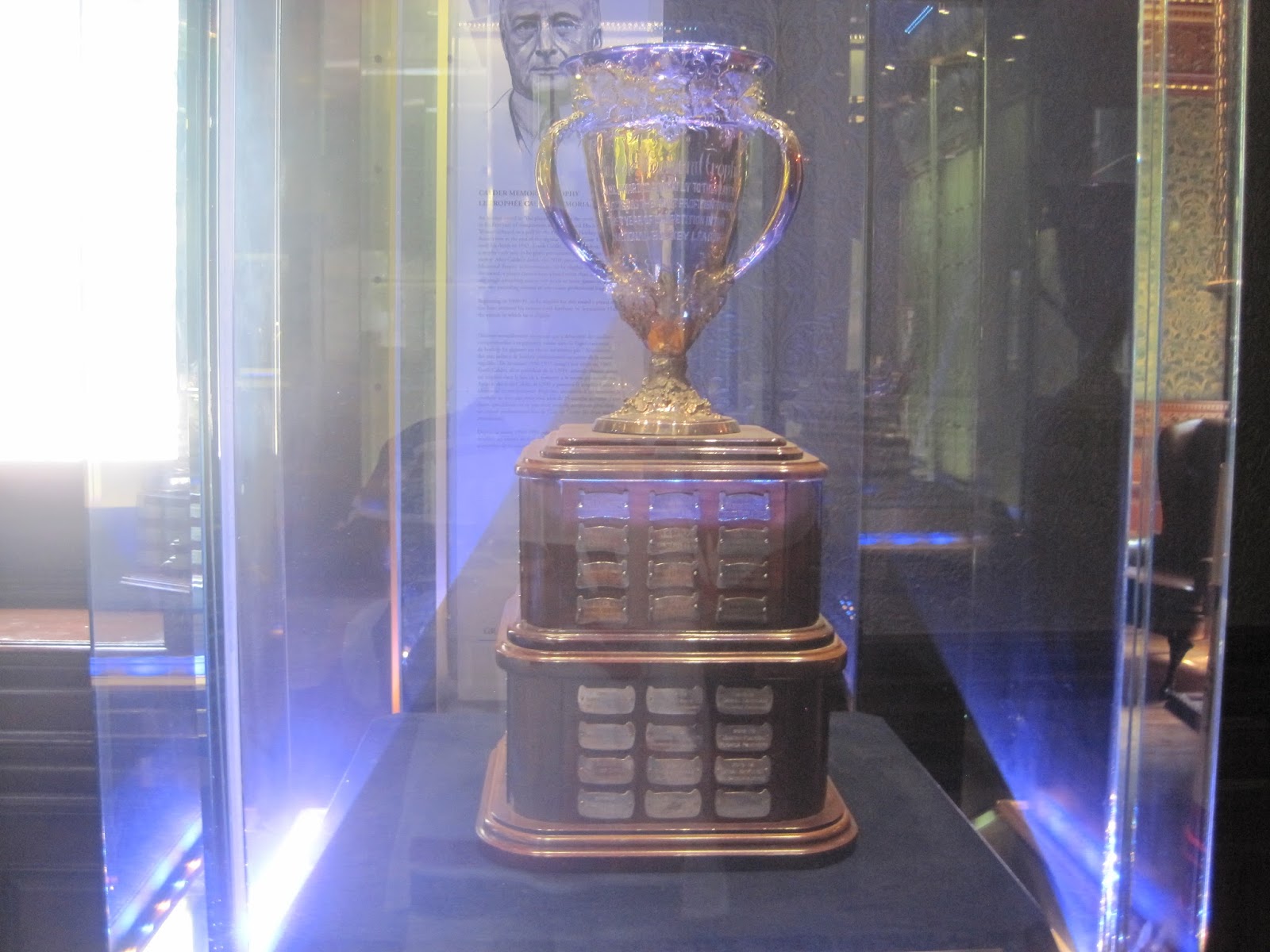
After the seemingly endless one-at-a-time reveal, we finally know the finalists for the NHL Awards.  I love the NHL Awards.  Mainly because they're all awesome trophies with cool names that they keep on display at the Hall of Fame.  Even if there do seem to be a few more than you see in other sports (imagine if the NFL had an award for best punter).

Anyway, some of the eventual winners are fairly obvious, while I have no idea who's going to win some others.  But I was also surprised that some players I thought would definitely be in the running weren't even finalists for the award I expected.  For example, how is Braden Holtby NOT a Hart Trophy finalist?  He had a better year this year than Carey Price did last season, when he won both the Vezina and the Hart.  Likewise, can someone tell me how Dylan Larkin isn't a finalist for the Calder Trophy?

The NHL has a lot of awards, but I'm going to narrow my picks down to the eight biggest ones, which doesn't include the Ted Lindsay Award since it's voted on by the players (although, interestingly, Holtby IS a finalist for the Lindsay, proving the players sometimes know better than the media).

Hart: Patrick Kane (Blackhawks)-Like I said, I'm shocked Braden Holtby isn't a finalist.  I figured this would be a nice battle between Kane and Holtby.  I was just trying to figure out who the third finalist would be.  Holtby certainly should've finished in the top three over Sidney Crosby.  But since he's not a finalist, I don't see how Patrick Kane isn't the MVP.  He led the NHL is scoring by a wide margin, becoming the first American scoring champion.  He'll also become the first American-born Hart Trophy winner (Brett Hull was born in Canada).

Vezina: Braden Holtby (Capitals)-Duh.  They didn't really need to name any other finalists for the Vezina.  This is the biggest no-brainer of them all.  Holtby's name is probably already engraved on the base.  He tied Martin Brodeur's record with 48 wins for a Capitals team that had the best record in the league.

Norris: Drew Doughty (Kings)-Ottawa's Erik Karlsson won it last year and will probably win it again this year.  He had 82 points in 82 games, becoming the first defenseman with a point a game in 20 years.  But this is my pick, not who I think will win.  And I'm going with Drew Doughty.  Simply because I think he's the best defenseman in the NHL at the moment.

Calder: Shayne Gostisbehere (Flyers)-There were a lot of good rookies this season.  So many in fact that Larkin and Jack Eichel aren't even finalists.  Chicago's Artemi Panarin scored 77 points and led all rookies in both goals and assists, but he was Patrick Kane's linemate, so that has to be taken into account.  Gostisbehere didn't have nearly as big an offensive impact as Panarin, but he was a big reason why the Flyers made the playoffs.  They wouldn't have without him.

Selke: Patrice Bergeron (Bruins)-Bergeron is the two-time reigning best defensive forward, and I think he makes it three in a row.  Although, it'll be close between him and the Ducks' Ryan Kesler, who's never won the Selke, I think Bergeron's reputation will precede him and push him over the edge.  The third finalist is Anze Kopitar, who's the Kings' best player and I still think of more for his scoring than anything else, so a Selke nomination is quite a testament to his all-around game.

Lady Byng: Anze Kopitar (Kings)-Kopitar is also a finalist for the Lady Byng, and this is the one I think he wins.  His 16 penalty minutes were the most of the three finalists, but Kopitar also had a lot more ice time than either Loui Eriksson or Alekansder Barkov.  The other half of the critera for the Lady Byng is combining gentlemanly play with "a high standard of playing ability," and Kopitar certainly lived up to that end of the bargain, leading his team in points and ranking second in the NHL in plus/minus.

Masterson: Mats Zuccarello (Rangers)-How can you not give the award for "perseverance, sportsmanship and dedication to hockey" to the guy that suffered a brain contusion in last year's playoffs, only to come back and set a career-high for points while playing every game but one this season?  Pascal Dupuis has a compelling story, too, but Zuccarello is the clear winner here.

Adams: Gerard Gallant (Panthers)-You could make an argument for any of the three finalists as the NHL's Coach of the Year.  But I'm going with Gerard Gallant.  The Panthers came out of nowhere to win the Atlantic Division.  It's tough to go against Barry Trotz after that outstanding regular season the Capitals had.  But Washington being good didn't completely come out of the blue.  Dallas being good kind of did, especially their having the best record in the Western Conference, but we've already established that Lindy Ruff is an excellent coach.  Still, if you needed to choose a more unexpected team, I've gotta go Panthers over Stars.  As a result, I've gotta give Gallant the nod over Ruff.

Of course, there's one more major individual award that won't be handed out in Las Vegas.  Can't make predictions for who's going to win the Conn Smythe this early in the playoffs, though.  I can't even begin to narrow it down.  There are seven teams still in the running for the Cup.

Friday, May 6, 2016

An NHL-less Olympics?

Rene Fasel, the President of the International Ice Hockey Federation, said earlier this week that he doesn't expect the NHL to send its players to the 2018 Olympics in Pyeongchang, South Korea.  We heard this same chatter in the lead-up to the Sochi Games, which eventually did include NHL players.  The issue then was the same as it is now.  Somebody has to cover the players' insurance, and neither side wants to pay for it.

As a part of the negotiations that led to the NHL agreeing to go to Sochi, the IOC and IIHF agreed to pick up much of the tab for the insurance costs, which are actually pretty high.  Evidently, the IOC will no longer contribute to the insurance and travel for the hockey players.  As a result, the IIHF is left with a $10 million gap that it has to fill.  And the NHL, for its part, has come to expect certain provisions for interrupting its season to send its players to the Olympics.  The insurance and travel coverage are two of those provisions.

While I'm sure there's a middle ground that can be reached here, it would almost certainly be a deal-breaker if the NHL and NHLPA had to pick up those costs entirely themselves.  It's also worth noting that the NHL has nothing to gain by sending its players to the Olympics, which partially explains why the IOC and IIHF have been willing to grant such concessions in the past.

All hope is not lost.  But it doesn't look good right now.  Fasel optimistically put it at a 50/50 chance that the NHL players participate in Pyeongchang just as they have at the last five Winter Olympics.  Realistically, though, the number is more like 60 percent they won't and 40 percent they will.  Either way, they have to figure this out sooner rather than later because of the necessary planning.  The NHL has to make the 2017-18 schedule, and knowing whether or not they need to include an Olympic break is obviously an important detail.

Let's not kid ourselves, though.  This wouldn't even be an issue if the Olympics were somewhere else.  With Sochi, we knew there was no chance the NHL players weren't going to be there.  Why?  Because Sochi's in Russia, and Russia's a hockey hotbed.  Korea?  Not so much.  And, while Russia's not exactly convenient for the players based in North America, it's still a lot easier travel-wise (and on your body) to fly to Russia than it is to fly to Korea.  The same goes for 2022, which will also be in the Far East.

The first time the NHL shut the season down for the Olympics, they went to Japan in 1998.  But since then, it's been a back-and-forth between North America and Europe.  Salt Lake City and Vancouver obviously presented no logistical issues, and Torino and Sochi really didn't either.  And at least the trips to Europe were to areas where hockey is popular and many of the players are from.  That's not the case with the two upcoming Olympics in Asia.

Part of the reason the players ended up going to Sochi was because you had a group, led by Alex Ovechkin, who really wanted to go.  Ovechkin wanted to win an Olympic gold medal on home ice.  There are no Korean or Chinese players in the NHL, and their national teams are nowhere near the level of the top nations.  South Korea simply hopes to be competitive in 2018, and China's national team is so weak that there's talk that 2022 might be the first Olympic hockey tournament not to include the host.

If the 2018 and 2022 Olympics were in Sweden or Finland or Canada, we wouldn't be having this discussion.  There wouldn't be any doubt the NHL players would be representing their national teams.  But they don't see the value of shutting down the season to go to Korea or China, although both represent a great opportunity to grow the game beyond the traditional European/North American hotbeds.

I don't think we've heard the last word about this, though.  Because there's one key group that hasn't been considered: the broadcasters.  NBC and CBC are the North American broadcasters that currently have Olympic rights.  They're also the primary networks for NHL coverage.  You think they have any interest in covering a hockey tournament that doesn't include NHL players?  Likewise, if the NHL players aren't at the Olympics, they're stuck in the awkward position of trying to work their regular NHL coverage around their Olympic coverage.  And what about Doc Emirck?  Do you have him cover a second-tier Olympic tournament and not do the NHL?  Or do you have him stick with his regular NHL gig and not have your best hockey play-by-play guy doing the Olympic hockey tournament?

Reaction to the NHL's participation in the Olympics has always been mixed.  From the media to the fans to the executives to the players themselves, some think it's a great idea and some have never been on board.  But everyone can agree that the quality of these tournaments has been first-rate.  And after having NHL-level hockey at the last five Olympics, they can't really go back.  Because it would be a very different tournament, and it might not be one worth watching.

Even the World Championships, which are always held during the Stanley Cup Playoffs and feature players whose teams either didn't make it or were already eliminated, are nowhere near the same quality as the Olympics.  The World Cup of Hockey returns this year for the first time since 2004, so we'll at least have something (although you can't really trust in the regularity of a tournament that had an eight-year gap between the first two editions and now 12 years between the second and third installments).

Both the NHL and NHLPA insist that the World Cup of Hockey isn't meant to "replace" the Olympics for the players.  I sure hope so.  For everyone's sake.  Because you don't know what you've got 'til it's gone.  The NHL has proven that it can make it work.  They owe it to everybody to try and do it again.  That way we'll get the Olympic tournament we've come to expect.  And deserve.

Tuesday, May 3, 2016

What Would George Do?

Finally.  Finally somebody in the front office said something about the Yankees, who have been downright awful so far this season.  It was general manager Brian Cashman who called the players to task, saying in not so many words that if things didn't change soon, he'd have to change things for them.  He also indicated that owner Hal Steinbrenner is "not happy."  Of course, if Hal's father was still around, it wouldn't have taken this long.  There already would've been changes.

George Steinbrenner, of course, was notorious for his lack of patience whenever the Yankees struggled, especially when it came to his managers (as George Costanza put it, "He fires people like it's a bodily function!").  So, if The Boss was still alive and running things, Joe Girardi's job would likely be in jeopardy.  He might even have been let go already.  (George Steinbrenner did get softer in his later years and let both Joe Torre and Girardi ride out rough stretches

But Cashman gave no indication that Girardi's in any sort of trouble.  Rather, he put the onus on the players.  They're not performing up to their capabilities (and expectations), so it's on them to right the ship.  If not, the "changes" that have been promised will likely be players either being traded or released.

So, who are the biggest culprits?  Well, we've got to start with Chase Headley.  Yankees third basemen are the only position in baseball without an extra-base hit this season.  That's just difficult to even fathom.  Then there's Aaron Hicks.  I was so excited about that trade during the winter, and Hicks has been great defensively.  But he hasn't hit a lick.  His average was below .100 for a while.  I think it still is.  And Mark Teixeira has been victimized by the shift more times than I can count.

Girardi, in his frustration, has said that if he could change anything about baseball, he'd outlaw the shift.  The Yankees have been shifted against more than any other team in baseball...by a wide margin.  But that's the way the game is played now, and it doesn't look like opposing teams are going to stop shifting anytime soon.  So they'll have to figure out a way to beat the shift.  If not, we're gonna see a whole lot more of this.

The entire team hasn't hit all season.  The Yankees are last in the Majors in scoring.  They've scored more than three runs only six times all year (and in one of those games, they had a whopping four!), and three of those were in the first four games of the season.  Simply put, it's tough to win when you don't score.  And the only way this team ever seems to score is on solo home runs.  I love the home run as much as the next guy.  But it would be nice if they hit one with somebody on base once in a while.  Or, better yet, if they got a couple hits in a row and scored in another way.  Then maybe they'd score more than once an inning.  Or maybe even score in multiple innings.

There have been a couple "bright" spots, but they're few and far between.  Starlin Castro has been great.  That trade may end up being one of the best moves Cashman ever made.  He and Brett Gardner seem to be the only guys on the team on base with any sort of regularity.  And A-Rod has been hitting home runs.  Although, it looks like he might be headed to the DL.

It's not completely on the offense, either.  The pitchers do get somewhat of a break because when the offense is only scoring two runs a game, they have virtually no margin for error.  But that doesn't mean the pitching has been good.  Not by a long shot.  Masahiro Tanaka has been the only consistent starter.  Luis Severino has been so bad that they're talking about sending him down, Michael Pineda gives up a few too many long balls, and Nathan Eovaldi can't seem to get past that one bad inning.  Even Dellin Betances has been lit up this season.

This isn't the first time this has happened.  In 2005, they had a terrible April, then called up a rookie by the name of Robinson Cano in May.  They went on to win the division title.  In 2013, they got Alfonso Soriano at the trade deadline and he resuscitated a moribund Yankees offense for the final two months of that season.  Soriano didn't lift them into the playoffs, but the point remains.

Problem is, they don't have a Cano waiting at Triple-A.  Reinforcements are on the way in the form of Aroldis Chapman.  But there's only so much a short reliever can do.  Especially on a team that can't score any runs.  How many opportunities will Chapman have to actually affect the game when they never have the lead in the late innings?  A relief pitcher isn't going to help the offense, so something more drastic might be in order.  Like releasing Headley, trading Carlos Beltran for a third baseman, and bringing Nick Swisher (who's currently in Scranton) back to play right field.

One month does not make a season.  You can't win the division in April, and you can't lose it in April either.  The Blue Jays were 50-50 after 100 games last year and won the division going away (acquiring David Price at the trade deadline certainly helped).  Likewise, the Yankees had an unexpectedly good April three years ago, but didn't make the playoffs.

If the 2016 Yankees want to be anything like the 2015 Blue Jays, though, they have to go back to being the Bronx Bombers.  And soon.  Otherwise, this is going to be a long season.  It already has been.  And it's only May.